Chevy 3.6 Timing Belt or Chain? Engine-Code Guide
Chevy 3.6 V6 uses timing chains, not a routine-service timing belt. Learn LY7, LLT, LFX, LGX and LGZ chain layouts, symptoms, codes, and maintenance guidance.
Chevrolet's 3.6L High Feature V6 families use metal timing chains, not a rubber timing belt. They therefore do not have a normal timing-belt replacement interval, but chains, guides, tensioners, sprockets, and cam phasers can still wear or fail.
The direct answer is chain. Chevrolet's 3.6L High Feature V6 engines drive their camshafts with metal timing chains and hydraulic tensioning components. That eliminates a scheduled rubber-belt change, but it does not make the system maintenance-free or interchangeable across every 3.6L badge.
Oil condition, oil level, pressure, guide wear, tensioner operation, cam phasers, and installation accuracy all influence chain timing. When a fault is suspected, read the engine code and diagnostic data before buying a generic kit. A timing correlation code identifies a relationship problem; it does not prove that the chain alone is the failed part.
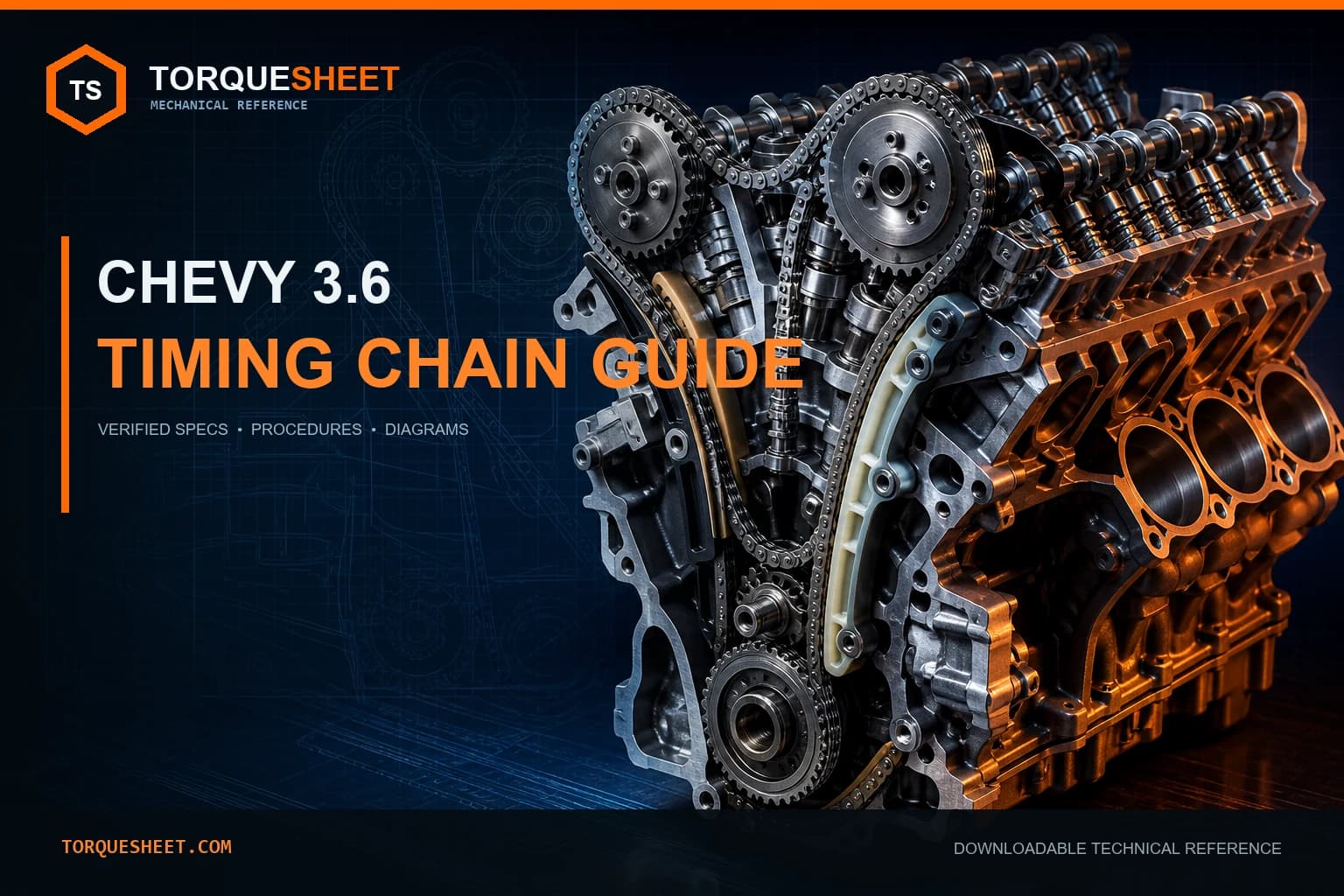
Interactive Chevy 3.6 timing-chain system map
Branded downloads includedPNG and PDF exports carry the TorqueSheet logo, torquesheet.com, source-page URL, and republishing attribution request. The PDF source link is clickable.
Select each stage to review the chain-driven relationship. This conceptual map does not replace engine-code-specific timing-mark instructions.
Chevy 3.6 Timing Belt Or Chain
| APPLICATION / ITEM | SPECIFICATION | NOTES |
|---|---|---|
| Camshaft drive type | Timing chain | Metal chain system; not a rubber timing belt |
| Routine belt-style interval | None | Inspect/diagnose based on exact manual, symptoms, and codes |
| Earlier 3.6L families | LY7 / LLT / LFX | Chain layout and service kit must match the engine |
| Later 3.6L families | LGX / LGZ / LFY | Later-generation multi-stage chain procedures are engine-code specific |
The 3.6L name spans LY7, LLT, LFX, LGX, LGZ, LFY and related codes. Parts and installation timing marks differ, so identify the RPO/VIN engine code before ordering or disassembly.
How to use this specification correctly
- 01
Decode the VIN and service-parts label to identify the exact 3.6L RPO, model year, vehicle platform, and whether the engine has been replaced.
- 02
Check oil level and condition using the owner-manual procedure, review oil-change history, and verify the correct viscosity and approval before mechanical diagnosis.
- 03
Scan all modules for current, pending, and history codes; save freeze-frame data and compare commanded versus actual camshaft positions with a capable scan tool.
- 04
Listen for startup rattle, inspect for external leaks and debris, and test the oil-pressure and actuator circuits using the engine-specific service procedure.
- 05
If internal timing work is justified, obtain the correct locking tools, timing-mark diagrams, fastener replacements, sealants, and chain kit for the exact RPO.
- 06
After repair, rotate the engine by hand as directed, verify every timing reference, prime lubrication where required, clear codes, perform relearns, and confirm live cam data and leak-free operation.
Why the Chevy 3.6 uses chains instead of a belt
A timing chain runs inside the engine behind a sealed cover and is lubricated by engine oil. A timing belt normally runs dry behind external covers and has a mileage/time replacement schedule. GM's technical documents and replacement parts identify chains, guides, sprockets, and tensioners for the 3.6L High Feature V6.
The absence of a belt interval means owners should follow the oil-life and maintenance schedule, not ignore the system. Chain tensioners depend on correct oil supply, and contaminated or low oil can aggravate wear and control problems.
Engine codes matter more than displacement
Early LY7, direct-injected LLT, lighter LFX, later LGX/LGZ/LFY and related variants share a broad architecture but differ in chain arrangements, cam phasers, sensors, fasteners, seals, calibrations, and timing references. A kit advertised only as 'Chevy 3.6' is not enough identification.
Use the RPO label, VIN decoder, casting/part numbers, and service information. If an engine was swapped, the VIN may identify the original vehicle rather than the installed assembly. Photograph labels and timing-cover details before ordering parts.
Symptoms that can indicate a timing-system problem
These signs are not conclusive by themselves. Low oil, incorrect viscosity, actuator solenoids, wiring, sensors, phasers, oil pressure, previous assembly error, or internal damage can mimic a stretched-chain diagnosis. Follow the published diagnostic tree.
- Brief or sustained rattle at cold start
- P0008, P0009, P0016, P0017, P0018 or P0019 correlation codes
- Reduced power, rough idle, hard start, or extended cranking
- Camshaft actual position that cannot follow commanded position
- Metal or plastic guide debris in oil or filter
- Persistent misfire after ignition and fueling checks
Oil maintenance and chain life
Use oil meeting the current dexos specification and viscosity printed in the exact owner manual. Keep the level in range, repair leaks, and avoid extending intervals beyond the oil-life monitor or severe-service requirements. A chain system circulates the same oil that carries combustion byproducts and protects small hydraulic passages.
An oil change cannot repair worn guides or restore an elongated chain. Additives and heavier oil should not be used to silence a mechanical fault. If noise, codes, or metal debris remain, diagnose promptly to reduce the chance of loss of cam timing and secondary engine damage.
What a complete chain repair may include
Depending on engine code and diagnosis, service can involve primary and secondary chains, guides, tensioners, crank and cam sprockets, phasers, one-time-use bolts, cover seals, front crank seal, gaskets, oil, coolant, and cleaning debris from the lubrication system. Replace only what the current service document and inspection justify.
Installation is precision work. Colored links are assembly aids and may not realign after the engine is rotated. Count links or verify timing relationships exactly as GM directs. Never assume a diagram for one RPO applies to another generation.
When to replace the timing chain
There is no universal mileage at which every Chevy 3.6 chain should be replaced. Replace components when diagnosis confirms wear, damage, loss of tension, incorrect timing, or another condition covered by the engine-specific procedure. Preventive replacement can make sense during related engine work only after evaluating cost, history, and component condition.
If the engine runs normally, carries no correlation codes, receives correct oil service, and live timing data is in range, a search result alone is not a reason to open the timing cover. Keep records, respond to warning signs early, and use a technician familiar with the exact High Feature V6 generation.
Chevrolet 3.6L High Feature V6 specifications can change by model year, engine, platform, wheel, and installed component. Confirm the VIN or engine identity, part numbers, fastener condition, and the current manufacturer instructions before service.
Chevy 3.6 Timing Belt or Chain? Engine-Code Guide FAQs
Does a Chevy 3.6 have a timing belt or chain?+
It uses timing chains. Verify the exact engine RPO because layouts and parts differ across 3.6L generations.
When should the Chevy 3.6 timing chain be replaced?+
There is no routine belt-style interval. Replacement is based on diagnosis, wear, codes, noise, and engine-specific service information.
What codes are associated with Chevy 3.6 timing problems?+
Correlation codes can include P0008, P0009, and P0016 through P0019, but diagnosis must rule out oil, actuator, wiring, sensor, phaser, and assembly issues.
Can an oil change fix timing-chain rattle?+
Correct oil level and quality matter, but fresh oil cannot repair worn chains, guides, tensioners, or phasers. Persistent noise needs diagnosis.
Are all Chevy 3.6 timing-chain kits the same?+
No. Match the vehicle, year, engine RPO, production break, and current parts information before ordering.
Technical sources
TorqueSheet favors engine- and component-specific manufacturer instructions over unsourced universal values.
1GM TechLink — High Feature V6 timing-chain installationGM technical publication showing the multi-stage timing-chain system on later 3.6L High Feature V6 engines.↗2GM service bulletin — 3.6L High Feature V6 timing chainsGM bulletin identifying LY7, LLT, LFX and related 3.6L applications as timing-chain engines.↗